11. The Stories of Panama Holidays
The Stories of Panama Holidays
Catholicism and independence are the two great themes of Panama's holidays—and Panamanians have mastered the art of having a good time. Here's a month-by-month journey through them all.
It seems like every time I touch base with my Panamanian architect, he and his wife are celebrating a holiday...😄...and my excitement about living in Panamá mounts.
Of course, this is partly because my future home + nature and book retreat feels a little more real, but also because I'm starving for culture.
Although San Diego is wonderful in many ways, it falls very short in the culture department.
I'm also a sucker for tradition, probably because I haven't had much of it in my life.
My Polish grandparents didn't pass down anything, apparently in an attempt to become American through and through.
Holidays tell the story of a culture. And, Panama has quite a story to tell...
Catholicism and independence are the two primary themes of Panama holidays. The culture is steeped in tradition and abundant on pride—and Panamanians have mastered the art of having a good time.
I am impatiently waiting to experience every one of these holidays in person in Panama beginning in 2021. Of course, I'll be sharing our experiences and my photos here!
Until then, I have this:
December 31 & January 1 — New Year's Eve & Day
A year of Panama holidays begins with New Year's Eve…
If you're in Panama City, you'll want to check out one of the best fireworks shows in Central America—beginning at midnight and lasting until early the next morning. Click here for some of the best places to watch them!
You'll also see strange (sometimes unsettling) life-sized effigies everywhere. Known as "muñecos de año viejo" (old year dolls), they are the creator's representation of something good or bad about the past year—it may be an admired celebrity or a political or cultural figure that everyone is happy to leave behind in the old year. Come midnight, they are burned to symbolize the fresh start the new year brings.
This is just one of many superstitions that comes out on New Year's Eve—click here to read about more!
January 6 — Día De Los Reyes Magos (Three Kings Day)
Día De Los Reyes Magos (Three Kings Day) ends the first holiday season of the year.
The night before, children leave out their shoes (or shoeboxes) to be filled with little gifts by the three wise men, and "rosca de reyes" (king cake) is a traditional dessert that is eaten in honor of this day.
A minor holiday overall, it is most celebrated in the town of Macaracas in the Los Santos province. At the center of the town's celebration is a play that reenacts the visit of the trio to the manger, an ox-drawn cart parade, folkloric shows, and often the construction of a mud house for a family in need.
Read about a Three Kings' Day celebration in Altos de Pacora.
January 9 — Día de los Mártires (Martyrs' Day)
Día de los Mártires (Martyrs' Day) is the anniversary of the Panama Canal Zone riot that occurred on January 9, 1964.
After the U.S. helped Panama achieve its independence from Colombia in 1903, they established the "Canal Zone," an area entirely under their control that included the Canal. (I highly recommend reading The Path Between the Seas by David McCullough for the (long) story of the construction of the Panama Canal.)
Just before his assassination in 1964, U.S. President John F. Kennedy had agreed to fly the Panamanian flag alongside the U.S. flag on all non-military locations inside the Canal Zone. After his death, his successors ordered that all flags be removed, however a group of Zonians hoisted the U.S. flag anyways.
When a small group of Panamanian students attempted to fly the Panama flag beside it, a scuffle ensued, the Panamanian flag was torn and the situation became violent. In the end, four Americans and 21 Panamanian students were dead.
The events of this day are considered to be the start of the very long process of the return of the Canal to Panamá.
This memorial holiday begins with a march retracing the students' steps and ends with speeches, many by survivors of the fateful day.
Click to watch a video from 1964!
Photo by Plinio Benevides on Pixabay
February and/or March — Carnaval (Carnival)
Carnival (Carnaval) in Panama is another multi-day celebration, beginning on the Friday before Ash Wednesday and also including Shrove Monday and Mardi Gras (Fat Tuesday).
Don't expect any business to get done during this time—businesses and schools are shut down while pretty much the entire country parties.
A blend of African, European and Central American customs and traditions originating in colonial times, this popular event is the last chance to indulge in revelry before the fasting of Lent begins, as well as an opportunity to both honor and mock the foreign culture that came with Spanish domination.
It became an official holiday in 1910.
Today, elaborate parades, floats, queens, bands, loud music, dancing, elaborate costumes, and "la mojadera" (water spraying) are all a part of this vibrant celebration. You'll also see many a demon scaring evil spirits away—they are mischievous so take care!
At the heart of Carnival is the "feud." This "battle" is rooted in colonial days when two neighborhoods—Calle Arriba and Calle Abajo—had a fierce rivalry. It's no less intense today and even more extravagant with the winner having the honor of their queen reigning for the next year.
The celebration ends with the "Entierro de la Sardina" (Burial of the Sardine). Yes, a sardine. In a tiny coffin.
And, then begins the 40 days of Lent.
Typically, Carnival is a time of "battle" between the queens and their courts from Calle Arriba (upper street) and Calle Abajo (lower street). During these days, they are enemies, but they are friends the rest of the year.
Las Tablas is THE place to go to experience Carnival. It's also especially vibrant in Chitré, Penonomé, Pedasí, Los Santos, Dolega, David, Capira, Aguadulce, San Miguelito, and Panama City.
It begins on a Friday with the crowning of the queen. Then, from Saturday morning to Tuesday afternoon, the streets are packed with people having fun. The festival ends in early Wednesday morning with the traditional burial of the sardine.
Read more about Carnaval here.
Photo by Myriam Zilles on Pixabay
March or April — Holy Week (including Easter)
Holy Week (or Semana Santa in Spanish) is a somber Catholic group of holidays centered on the crucifixion and resurrection of Jesus Christ. It is celebrated during the week leading up to Easter Sunday, so the dates vary from year to year.
This is a significant Panamanian holiday and many businesses are closed, thus services are limited.
Celebrations include processions (with people dressed in traditional clothing and marching through the streets carrying statues of saints and other religious figures and reenacting biblical scenes), beach trips to celebrate the start of the beach season, fasting and prayer, eating traditional foods and visiting churches.
It includes the following observances:
- Palm Sunday (the Sunday before Easter)—commemorates Jesus' triumphal entry into Jerusalem
- Maundy Thursday (the Thursday before Easter)—commemorates Jesus' offering of the Eucharist at the Last Supper
- Good Friday (the Friday before Easter)—commemorates Jesus' Passion, crucifixion, and death
- Holy Saturday (the Saturday before Easter)—commemorates the day that Christ lay in his tomb after death
- Easter Sunday—commemorates the resurrection of Jesus
Each region has its own traditional customs and activities, including church services, reenactments (typically Way of the Cross and Passion of Christ performances), and processions. No alcohol can be purchased at restaurants or stores on certain days.
Read more about Holy Week here.
May 1 or 2 — Día de los Trabajadores (Labor Day) | May Day
Día de los Trabajadores (Labor Day), also called May Day, is a day off for most, as businesses and schools are closed.
The holiday is a celebration of workers, and the successful fight for their rights, and the beginning of spring.
May, June or July — Corpus Christi
Corpus Christi is another Catholic holiday dating back to the mid-1200s that commemorates the Eucharist. The date of this holiday varies from year to year as it happens 60 days after Good Friday, usually between late May and early July.
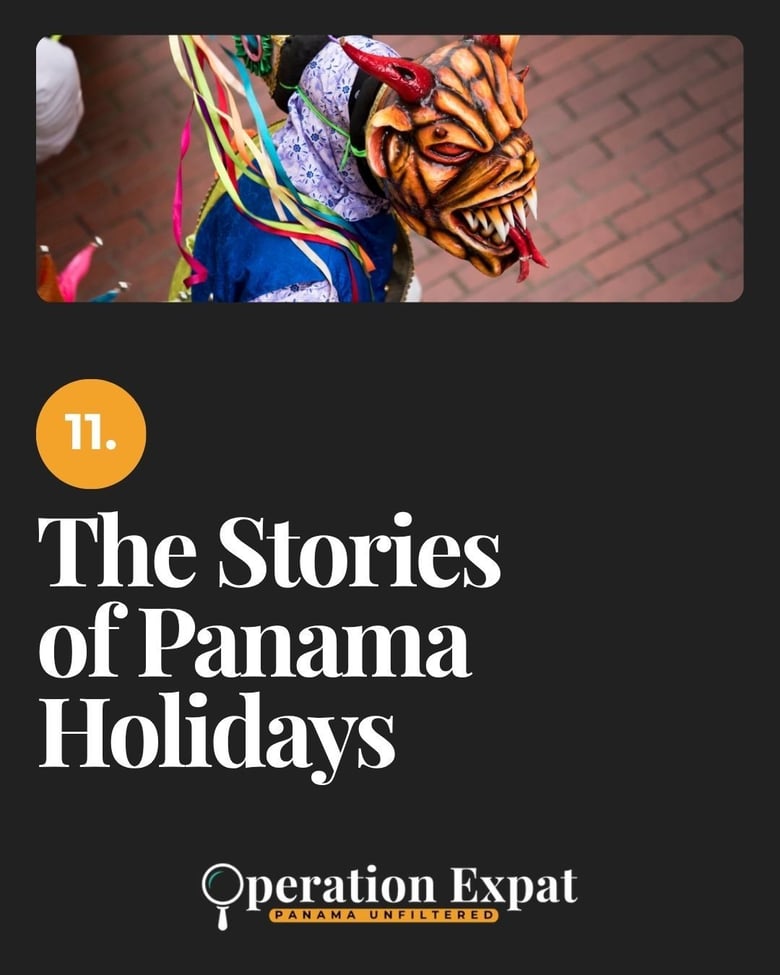
This is one of the most colorful and dramatic of Panamanian holidays, especially in the town of La Villa located in the Los Santos province on the Azuero Peninsula. People dress up in vibrantly colored and intricately made demon and angel costumes and dance down the streets, acting out battles between good and evil.
In the traditional celebrations of Corpus Christi in the Los Santos province, characterizations of the "Dirty Devil" appear. His costume is colored stripes, usually red and black. Long feathers complete the design of the stunning masks.
According to Mi Tierra Santeña, the devil has been interpreted in different ways in Panamá. It began with the purpose of introducing the Catholic religion to the indigenous people; not having mastered the Spanish language, they were able to understand the messages through dramatizations and mimes.
Click here for more info on Corpus Christi.
June — Father's Day
Similar to other countries, Father's Day is on the third Sunday in June and is celebrated by honoring one's father (or father figure). Unlike Mother’s Day, it's not an official national public holiday, just a day of family gatherings and treating fathers to special meals, outdoor activities, and gifts..
July — Día del Niño (Children's Day)
Día del Niño (Children's Day) is celebrated on the third Sunday of every July and promotes the importance of children's rights and their place in the development of our society.
It is a day to celebrate the achievements of all children, but above all it is a day to draw attention to the most disadvantaged children, to raise awareness of children's rights, and to make people aware of the importance of working every day for their well-being and development.
July 22 — Día de la Pollera (Day of the Pollera) in Las Tablas
By order of Municipal Decree #15, signed into law on July 16, 1957, the Las Tablas District declares July 22 as Pollera Day. Polleras are the beautiful traditional dresses that Panamanian women wear during special occasions throughout the year.
August 15 — Foundation of Old Panama City
Foundation of Old Panama City is a public holiday established in 2015 that celebrates both the founding of Panama Vieja and the opening of the Panama Canal.
Most people have off as most businesses and schools are closed.
August 22 — World Folklore Day
This day highlights the country's vibrant and diverse folklore, including music, dance, traditional clothing, food, legends, myths, superstitions, and crafts, and aims to promote and safeguard these traditions, ensuring they are passed down through generations as a symbol of national identity, or "panameñidad." Learn more.
September — Festival de la Mejorana (Guararé)
The National Festival of the Mejorana is one of the most important folklore events in Panamá and has been celebrated since 1949.
Held in September in Guararé, delegations come from all over the country to share their native dances and music and there are numerous contests held throughout the event.
Click here to visit the official festival website.
October — Parade of Carts (El Desfile de las Carretas) (Pedasí)
The "Parade of Carretas" is an annual three-day festival and parade that takes place at the end of October in Pedasí.
The event, which kicks off the independence holidays in November and is one of the most popular cart parades in Panamá, is a wonderful display of Panamanian tradition and includes traditional costumes, music, dancing, a parade of ox-drawn carts, a bull run, and a violin contest.
Read more about El Desfile de las Carretas.
October 21 — Festival del Cristo Negro ♰
The "Festival of the Black Christ" is an annual Catholic pilgrimage that takes place in Portobelo.
This is an especially important holiday for those of African descent as it is also a protest against Spanish colonialism, slavery and racism.
At the center of the festival is a life-sized wooden statue of a dark-skinned Jesus, known as "Cristo Negro" and "El Nazareno" and of unknown origin, that is purported to have arrived in Portobelo in the 1600s when the majority of the city's population was from Africa.
Some of the pilgrims come dressed in purple robes, as a symbol of their suffering, to seek forgiveness for their sins. After a traditional procession through the streets of Portobelo comes music, drinking and dancing.
Read more about the Festival del Cristo Negro.
November 2 — Día de los Fieles Difuntos (All Souls Day) | Día de los Muertos (Day of the Dead)
In Panamá, Día de los Muertos is a subdued, but significant, holiday dedicated to the reflection and remembrance of people who have passed away.
Families will often visit cemeteries to clean and place flowers and trinkets on the graves of their loved ones. Masses are held in churches to pray for the souls of the deceased.
Most of the official celebrations are held at the Amador Cemetery in Panama City's El Chorrillo neighborhood as it has some of the oldest and more significant graves in Panama.
Although it's not an official national holiday, many government offices and private companies will be closed. No alcohol is sold at stores or restaurants and no loud music can be played.
Click here to learn more about Día de los Muertos.
November 3 — Separación de Panamá de Colombia (Separation Day)
Separation Day commemorates Panama's separation from Colombia on November 3, 1903, which marked the birth of the Panamanian nation. It is the first—and one of the most important—of the country's "Fiestas Patrias," the patriotic holidays that fill the month of November with parades, marching bands, and flag-waving celebrations across the country.
Click here to learn more about Separation Day.
November 4 — Día de los Símbolos Patrios / Día de la Bandera (Flag Day)
Flag Day, which is held annually on November 4, connects Separation Day and Colón Day and honors the creation of the Panamanian flag by María de la Ossa de Amador in 1903.
The flag of Panama is divided into four quarters. In the upper left and lower right white quarters are a five-point blue star and five-point red star, respectively, and the upper right quarter is red and the lower left quarter is blue.
The colored quarters and stars symbolize the two rival political parties—blue for Conservatives and red for Liberals. The white behind the stars represents the peace under which they run the country.
The day is celebrated by flag raising ceremonies, individuals proudly flying the flag and, of course, more festivals.
Click here to read the story of the Panamanian flag.
November 5 — Día de Colón (Colón Day)
Held on November 5 every year, just after Separation Day and Flag Day, Colón Day commemorates the official end to Panama's Colombian era.
Though Panama had declared independence from Colombia just a couple of days prior, a battalion of Colombian soldiers still in Colón was planning a march on the city. As a result of the offensive actions taken by locals, they were not successful.
November 10 — Primer Grito de Independencia de la Villa de los Santos (First Call for Independence)
This national holiday, held annually on November 10, commemorates the start of the battle for independence from Spain.
Panama's fiercest fight for independence began in Los Santos on the Azuero Peninsula when locals here openly declared their separation from the Spanish Empire.
Click here to learn more about the "Fiestas Patrias" holidays.
November 28 — Independencia de Panamá de España (Independence Day)
Independence Day is the fifth holiday in the month of November and celebrates Panama's official independence from Spain on November 28, 1821.
In 1519, Panama City became the first European settlement as part of the Spanish Empire. From 1538 through 1821, Panama was governed by Spain through the Viceroy of Peru.
Immediately after, Panama joined the Republic of Colombia, also known as Gran Colombia, in order to maintain their independence from Spain.
December 1 — Teacher's Day
Teachers' Day in Panama falls on the anniversary of the birthday of Manuel José Hurtado, known as the "Father of Panamanian education." Born in 1821, he modernized and improved education in Panama and founded many schools and colleges. Therefore, on his birthday, students and parents express their appreciation of teachers.
December 8 — Mother's Day
December 8 is a national holiday to honor mothers in Panama that also falls on the same day as the Feast of the Immaculate Conception.
Other than it being a national public holiday, and typically beginning with a family trip to church, it is celebrated much the same as in other countries with attention and gifts lavished upon mothers.
December 20 — National Mourning Day
National Mourning Day is a national public holiday in Panama on December 20th each year. The holiday commemorates the Panamanians who died during the 1989 U.S. invasion of the country.
December 25 — Christmas
The Christmas holiday celebration kicks off in Panama City with a huge parade with bands, floats, live performers, and lots of food.
Nine days before Christmas, some neighborhoods hold the Spanish Las Posadas where families build a shelter out of palm fronds on their property and two of the community's children dress up as Mary and Joseph. Every night until Christmas Eve they recreate their search for a room at an inn and end with singing, piñatas and traditional Panamanian food.
Christmas Eve is the highlight of the season, celebrated with fireworks, dancing in the streets, and visits to relatives. Typical meals are chicken tamales and arroz con pollo, turkey with relleno stuffing, fruit and fruitcake, and Ron Ponche (spiked eggnog).
Christmas Day is traditionally spent at church in the morning and with family and friends the rest of the day.
NOTE: If a roving holiday falls on a weekend, the Monday following will be observed as a public holiday.
I hope these stories of Panama holidays have you as excited as I am. If you've already had some amazing experiences, please share a tidbit (or two or three) in a comment below!
The one that's missing from the list…
I would be remiss if I didn't mention December 20…
Although it's not officially recognized, this day is unofficially observed by many Panamanians. On December 20, 1989, the U.S. unleashed Operation Just Cause on Panama City, bombing the El Chorrillo neighborhood in an attempt to overthrow Manuel Noriega.
As you walk around Casco Viejo and El Chorrillo today, you will find graffiti with this date—reminding people to never forget what happened to their fellow citizens and their neighborhood.
To learn more about Manuel Noriega and Operation Just Cause, I recommend the book Panama by Kevin Buckley from my Panama Reading List.
— Operation Expat
Embrace the culture, or escape?
Diving into the holidays is a huge part of truly embracing Panama. But are you moving here to embrace the culture—or to escape something else? An honest look.
Embrace or escape? →Subscribe to the Operation Expat Newsletter so you move to Panama with your eyes wide open! →