
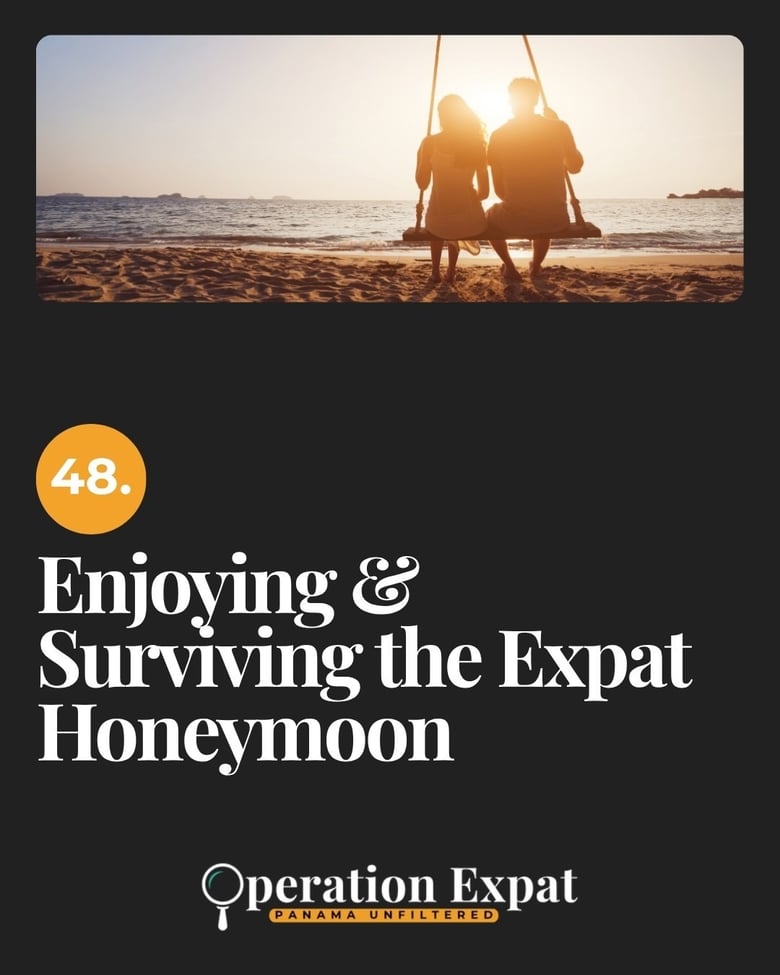
48. Enjoying & Surviving the Expat Honeymoon
Enjoying & Surviving the Expat Honeymoon
It's real, it's glorious, and it doesn't last. Here's how to savor it—without making decisions you'll regret when reality sets in.
I spent my first two years in Panama absolutely enchanted. Not just impressed or happy—enchanted.
I'd take walks through the jungle, sweating through my clothes and getting destroyed by insects, but I still looked around in genuine wonder, amazed by something as simple as the size and shape of a leaf.
Everything delighted me: the food, the pace of life, the way the sky looked at night, the long treks to the nearest town to shop for necessities, the kindness of the occasional strangers. It all felt like magic.
The less desirable stuff rolled off me like water on a duck.
This magic? It's the expat honeymoon. It's not false or delusional...what we experience during this time is real. The jungle really is beautiful. The food really is good. Some people really are warm. This is a time to soak up, to say yes to adventures, to fall in love with our new country.
But, just like a real honeymoon, it's important to understand that this glorious phase is temporary. Why? Because it's not always going to be like this...you're not always going to feel like this. The decisions we make during this intoxicated, enchanted phase can trap us for years. And that's where this gets serious.
What the expat honeymoon actually is
Psychologists have been studying cross-cultural adjustment for decades. The model most commonly cited is the U-curve model (developed by Oberg in 1960), which describes adjustment starting with a honeymoon stage, followed by culture shock, then adaptation and mastery.
During the honeymoon phase, we're seeing everything through rose-tinted glasses. Everything appears new and exciting, and we're living with a tourist's mindset. The novelty creates a psychological high—challenges feel like adventures, not obstacles. Our brain is flooded with dopamine and adrenaline. We're proud of ourselves for making this bold move. We're curious about everything. Life feels full of possibility.
Think of it like the first weeks of marriage: we're enchanted by all the little quirks that later might very well annoy us. We say yes to everything. We're patient with things that would normally drive us crazy. We're not thinking clearly—we're thinking beautifully. That's not a flaw in the honeymoon phase. That's the point of it.
But here's the critical part: our tolerance for the harder things—the heat, the humidity, the bureaucratic absurdity, the time zone separation from family, the cultural gaps—is artificially high because we're still in adventure mode. We haven't yet learned that the things we love about a place can coexist with things that drive us absolutely insane.
How long does the honeymoon last?
Here's where the research gets honest—what takes one person a month may take another 8 months or a year, and there's no real "normal" when it comes to adjustment timing. Some people skip the honeymoon phase entirely. Others bounce between phases unpredictably.
My honeymoon lasted roughly two years—and I'd call that extreme. Most expat literature suggests it's closer to 2-6 months, though some research indicates it can extend into the first year. But the point isn't the timeline. The point is that we won't know when it's ending until it's already ended. There's no memo. No warning. Just a slow fade.
Then one day we realize: we don't want to take that jungle walk anymore because it's SO DAMN HOT. 🥵 The food we initially loved now feels boring. The pace we found charming now feels slow in a way that frustrates us. And it happens so gradually we can't always pinpoint when the shift occurred.
That's when the frustration stage kicks in—when those differences start to feel exhausting rather than interesting, and it's often the hardest part. We're no longer enchanted. We're living.
Here's the trap (and it's a big one): During Year 1 (or, in my case, 2), when we're still enchanted by Panama, we take a leap and buy property. We find the "perfect" place so it feels like the right move. We're happy. Why wait? The honeymoon is in full swing. So we commit. We sign the papers and...bam, we're locked in.
Then Year 2 (or 3) arrives. The heat that was novel now saps every bit of our energy. The noise that was novel is now annoying. The traffic drives us crazy. The bureaucracy that seemed quaint now feels like we're stuck in a bad movie. And we own a house. We're stuck with a major financial commitment to a place we're no longer sure we want to be.
This is not about regret. It's about being locked in before we actually know what we're choosing. Just like you wouldn't buy a house with someone you just met on Day 1 of dating—no matter how magical it feels.
Why major decisions during the honeymoon matter
This is the critical insight for anyone moving to Panama—experts recommend we not make any major decisions based solely on how we feel during the honeymoon stage. It's not the moment to sign a long-term lease, make major financial decisions, or conclude that everything will be straightforward.
Why? Because the odds are quite high that what we love and what we're willing to tolerate when we're in honeymoon mode might become completely intolerable once we're actually living a normal life here.
The tropical climate that felt romantic during exploration season might trigger migraine headaches or make outdoor activities unbearable. The slower pace that seemed relaxing might feel frustrating when you're trying to get something done. The cultural differences that fascinated you might start feeling isolating.
Think about it this way—you wouldn't propose to someone you just met, no matter how perfect they seemed. You wouldn't commit to a decades-long mortgage based on a weekend trip. So why commit to Panama—or to a specific neighborhood, a specific lifestyle, a specific life choice—when you're still riding the enchantment?
We can't know how we'll feel in Year 2 (or 3) until we actually live it. No amount of research or YouTube vlogs can tell us. Our nervous system has to live it for ourselves.
What happens after the honeymoon ends
Once an expat begins to actually live (and sometimes work) in their new country—dealing with everyday-life problems and facing challenges of language, culture, housing, and making friends—the culture shock stage sets in. This is rougher than the guides suggest.
In the frustration stage, differences stop feeling interesting and start feeling exhausting. We may become irritated by the host culture, compare everything with home, feel misunderstood, or lose patience with ourselves. Some expats describe it as the "What the F*** Have I Done" phase. And it's real.
But—and this matters—if we make it through this stage without catastrophizing or bailing, we gradually become more familiar with our surroundings, build a routine, and start feeling more comfortable in our new community. We reach an adaptation phase where you're not running on honeymoon energy anymore, but we're also not in crisis. We've accepted that life abroad has tradeoffs. We understand that we can love a place AND be frustrated by it at the same time. And we're okay with them.
If we don't make it through, having the ability to easily change our minds without experiencing financial hardship is crucial.
That's where the real decision lives. Not in Year 1 when everything's magic. In Year 2 (or 3) when we know what we're actually signing up for—the real, unglamorous, beautiful, frustrating, everyday version of living here.
The freedom that comes from renting through the honeymoon
Here's some practical advice: rent during your honeymoon. Don't buy property. Not because home ownership is wrong, but because it locks you in before you know what you're choosing. Just like you wouldn't make a major life commitment during a honeymoon, don't make a major financial one during your expat honeymoon.
If you're renting in Bocas del Toro and you hate the isolation by Year 2, you can move to the city. If you're in Coronado and the vibe is not your thing, you can try Boquete (or somewhere you won't even hear about until you live and explore here). If you commit to a specific neighborhood before the honeymoon wears off, you're gambling with your freedom. And you might lose.
Most of the people I know who thrive in Panama are the ones who gave themselves permission to adjust without being locked into a property decision. They explored. They tolerated discomfort. They let their feelings about where to actually live evolve as the initial enchantment wore off. They enjoyed the honeymoon without letting it make their life choices for them.
And when they finally did buy—if they did—they were buying because they'd chosen Panama with clear eyes, not because they were still riding the high.
That's the difference between the honeymoon and real life. One is a feeling. The other is a choice. Both are valuable. Just don't confuse them.
— Operation Expat
Join the Operation Expat community
Come to Panama with your eyes wide open!
Get honest, candid insights delivered to your inbox. No romance, no fluff—just real talk about expat life in Panama.
Subscribe
Comments (0)
Join the conversation
Be the first to share your thoughts on this post